
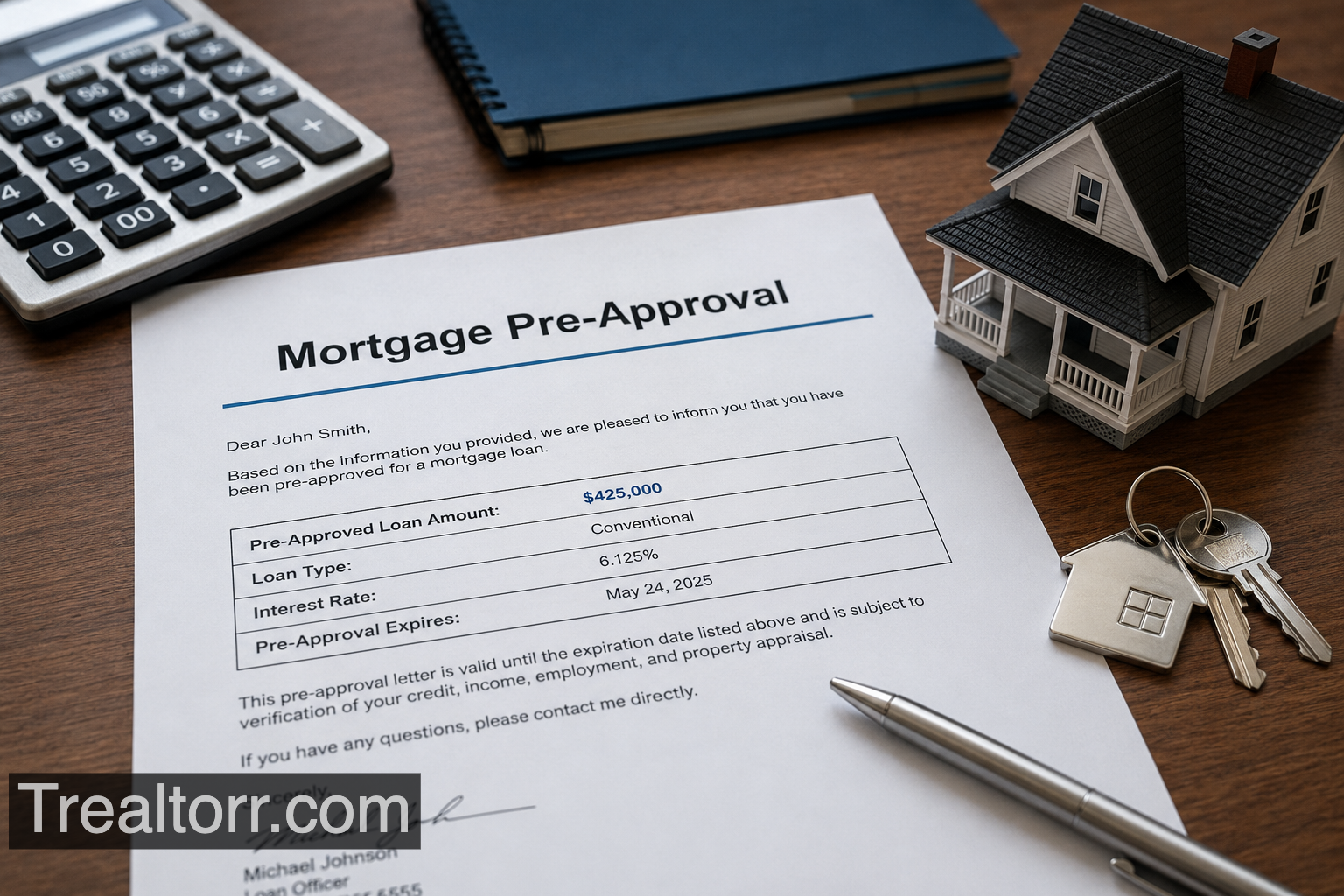
Mortgage pre-approval sounds official, but many buyers misunderstand what it really means. Some think it means they are already fully approved. Others think it is just a casual estimate. The truth is in the middle: a mortgage pre-approval is one of the most important early steps in the home-buying process, but it is not a final loan approval.
Here is the real hook: a strong pre-approval can help you shop with confidence, make stronger offers, and avoid wasting time on homes outside your budget. But a weak or rushed pre-approval can create stress later if the lender did not properly review your income, debts, credit, assets, or loan conditions.
This guide explains mortgage pre-approval in simple terms: what it is, what lenders check, how long it takes, what documents you need, how it affects your credit, what can go wrong, and how to use your pre-approval wisely when buying a home.
Quick Answer: What Is a Mortgage Pre-Approval?
A mortgage pre-approval is a lender’s written statement that you may qualify to borrow up to a certain amount based on the financial information reviewed. It usually involves a mortgage application, credit check, income review, asset review, and debt review.
A pre-approval letter can help show sellers and real estate agents that you are a serious buyer. However, it is still conditional. Final approval usually depends on the property, appraisal, title, updated financial documents, underwriting, and whether your financial situation stays the same before closing.
Pre-Approval vs Prequalification: What Is the Difference?
Prequalification and pre-approval are often used like they mean the same thing, but they are not always equal. A prequalification can be a quick estimate based mostly on information you provide. A pre-approval is usually stronger because the lender reviews more of your actual financial documents and credit profile.
| Feature | Prequalification | Pre-Approval | Why It Matters |
|---|---|---|---|
| Purpose | Quick estimate of what you may afford | Stronger review before making offers | Pre-approval usually carries more weight with sellers |
| Credit check | May be soft or none, depending on lender | Usually includes a credit pull | Credit score affects loan options, rate, and approval strength |
| Document review | Limited or based on self-reported info | Usually includes income, assets, debts, and employment review | Better document review can reduce surprises later |
| Seller confidence | Lower | Higher | A seller may prefer a buyer with a stronger pre-approval letter |
| Final loan guarantee? | No | No | Neither one is a guaranteed final loan approval |
What Lenders Check During Mortgage Pre-Approval
A lender is trying to answer one big question: Can this buyer reasonably repay the mortgage? To answer that, the lender looks at your income, employment, credit, monthly debts, down payment, savings, and sometimes the type of property you want to buy.
Graph: What Matters Most in a Mortgage Pre-Approval
This is a simple visual guide, not an exact lender scoring model.
1. Income
The lender checks whether your income is stable, documented, and likely to continue. W-2 employees may provide pay stubs and W-2 forms. Self-employed buyers may need tax returns, profit and loss statements, bank statements, or other business documents.
2. Credit
Your credit report helps the lender review credit score, payment history, open accounts, balances, collections, bankruptcies, late payments, and overall credit risk. A higher credit score can sometimes help you qualify for better loan terms.
3. Debt-to-income ratio
Your debt-to-income ratio, often called DTI, compares your monthly debt payments to your gross monthly income. Lenders use this to estimate how much mortgage payment you can handle. Car payments, credit card minimums, student loans, personal loans, and other recurring obligations can reduce your buying power.
Debt-to-income formula:
Monthly debts ÷ gross monthly income = DTI
Example: If your gross monthly income is $7,000 and your monthly debts are $2,100, your DTI is 30% before adding a new mortgage payment.
4. Assets and down payment
The lender checks whether you have enough money for your down payment, closing costs, and sometimes reserves. Reserves are extra funds left after closing. They can make a file stronger because they show you are not using every dollar just to buy the home.
5. Employment history
The lender may verify where you work, how long you have worked there, and whether your income is consistent. Job gaps, recent career changes, commission income, bonus income, overtime, and self-employment may require extra review.
6. Loan program fit
Not every buyer fits the same loan. Conventional, FHA, VA, USDA, jumbo, bank statement, and other loan types may have different rules. A good pre-approval should match your situation instead of forcing every buyer into the same option.
Documents Needed for Mortgage Pre-Approval
The exact documents depend on your job type, loan program, and lender, but most buyers should be ready to provide the following:
| Document | Why the Lender Needs It | Buyer Tip |
|---|---|---|
| Government ID | Confirms your identity | Use a clear, unexpired ID |
| Recent pay stubs | Shows current income | Provide all pages if the pay stub has multiple pages |
| W-2 forms or 1099s | Shows income history | Usually the most recent two years are requested |
| Tax returns | Important for self-employed, rental, business, or complex income | Self-employed buyers should prepare early |
| Bank statements | Shows funds for down payment and closing costs | Avoid large unexplained deposits before applying |
| Retirement or investment statements | May show reserves or additional assets | Only use money allowed by the loan program |
| Credit authorization | Allows lender to review credit | Ask if it will be a soft pull or hard pull |
| Debt information | Confirms monthly obligations | Tell the lender about debts that may not show clearly on credit |
| Gift letter, if using gift funds | Documents funds from family or approved donor | Do not move gift money randomly without lender instructions |
Important: Do not hide debts, side agreements, child support, business losses, cash deposits, or job changes from your lender. It is better to solve the issue early than discover it during underwriting.
The Mortgage Pre-Approval Timeline
Some buyers can get pre-approved quickly, while others need more review. A simple W-2 file with strong credit and clean bank statements may move faster. A self-employed buyer, buyer with recent credit issues, buyer using gift funds, or buyer with multiple income sources may need extra time.
Step 1: Start the application.
You provide your basic information, income, employment, assets, debts, and permission for the lender to review credit.
Step 2: Submit documents.
The lender reviews pay stubs, W-2s, tax returns, bank statements, ID, and any special documents needed for your situation.
Step 3: Lender reviews your file.
The lender checks credit, DTI, income stability, assets, down payment, and possible loan programs.
Step 4: You receive a pre-approval letter.
If the file looks acceptable, the lender may issue a letter showing a loan amount or purchase price range, subject to conditions.
Step 5: You shop for homes.
You use the pre-approval to shop within a realistic price range and make offers with more confidence.
Step 6: Final underwriting happens after a contract.
The lender still needs to review the property, appraisal, title, updated documents, insurance, and final loan conditions before closing.
What a Pre-Approval Letter Usually Shows
A mortgage pre-approval letter is usually short, but it can make a big difference when you submit an offer. The letter may include:
- Buyer name
- Lender name
- Estimated loan amount or purchase price
- Loan type, such as conventional, FHA, VA, or USDA
- Down payment assumption
- Expiration date
- Conditions or disclaimers
- Lender contact information
Some buyers ask for a custom pre-approval letter that matches the offer amount instead of showing their absolute maximum. That can help avoid revealing too much negotiating room to the seller.
Does Pre-Approval Mean You Are Guaranteed to Close?
No. Mortgage pre-approval is not a final loan approval. It means the lender has reviewed your information and may be willing to lend based on assumptions and conditions. Final approval usually happens later, after you are under contract and the full file goes through underwriting.
Common reasons a pre-approved buyer can still run into problems include:
- The appraisal comes in low
- The property has condition issues
- The buyer changes jobs
- The buyer opens new credit
- The buyer increases credit card balances
- Large bank deposits cannot be documented
- Income is lower than expected after review
- Debt-to-income ratio becomes too high
- Insurance quote is much higher than expected
- Tax or HOA costs are higher than estimated
- Title issues appear
Texas Buyer Tip: Pre-Approval Must Include Taxes and Insurance
For Texas buyers, a pre-approval should not be based only on principal and interest. Property taxes, homeowners insurance, HOA dues, MUD taxes, PID assessments, and flood insurance can change the monthly payment significantly.
If you are shopping in Dallas-Fort Worth, Houston, Austin, San Antonio, Wylie, Princeton, McKinney, Frisco, Plano, or growing Texas suburbs, ask your lender to estimate the full monthly payment for each home, not just the mortgage payment.
| Texas Cost | Why It Matters | Question to Ask Before Offering |
|---|---|---|
| Property taxes | Can be a major part of the monthly payment | What is the estimated monthly tax escrow? |
| Homeowners insurance | Premiums vary by roof, location, coverage, and risk | Can we get an insurance quote before option period ends? |
| HOA dues | Can affect qualification and monthly budget | What are the monthly or annual dues? |
| MUD or PID | Some communities have extra taxes or assessments | Is there a MUD, PID, or special assessment? |
| Flood zone | May require flood insurance | Is the property in a flood zone? |
What to Do After You Get Pre-Approved
Getting pre-approved is not the finish line. It is the starting line. After you receive your letter, protect your approval by keeping your finances stable.
Do these things
- Shop within a payment you actually feel comfortable with
- Compare different home prices by full monthly payment
- Ask your lender before moving money between accounts
- Save updated pay stubs and bank statements
- Keep paying bills on time
- Ask for a custom pre-approval letter before making an offer
- Get insurance quotes early
- Tell your lender if anything changes
Avoid these mistakes
- Do not open a new car loan
- Do not max out credit cards
- Do not quit or change jobs without talking to your lender
- Do not deposit large cash amounts without documentation
- Do not co-sign for someone else
- Do not assume the highest approval amount is the smartest budget
- Do not skip property tax and insurance estimates
Pre-Approval vs Loan Estimate: Do Not Confuse Them
A pre-approval letter and a Loan Estimate are not the same thing. A pre-approval letter shows that the lender may be willing to lend based on your file. A Loan Estimate is a formal mortgage disclosure that shows important details about a specific loan request, including interest rate, monthly payment, closing costs, and other loan terms.
Once you submit a mortgage application with the required information, the lender generally must provide a Loan Estimate within three business days. This is why comparing Loan Estimates from more than one lender can help buyers understand the real cost of the loan, not just the advertised rate.
| Item | Pre-Approval Letter | Loan Estimate |
|---|---|---|
| Main purpose | Helps you shop and make offers | Helps you compare loan terms and costs |
| Issued when | Before or during home shopping | After a mortgage application for a specific loan |
| Shows closing costs? | Usually no detailed breakdown | Yes, estimated closing costs are shown |
| Guarantees approval? | No | No |
| Best use | Offer strength and budget planning | Loan comparison and cost review |
How Long Does Mortgage Pre-Approval Last?
Many pre-approval letters are valid for around 60 to 90 days, but this depends on the lender. If your letter expires, the lender may need updated pay stubs, bank statements, credit information, or employment verification.
Even if the letter has not expired, your approval can still change if your credit score drops, debts increase, income changes, interest rates move, or the property costs more than expected.
How to Make Your Pre-Approval Stronger
A stronger pre-approval can help you shop with more confidence and may make your offer more attractive to sellers. Here are practical ways to improve it:
- Lower credit card balances: High balances can hurt credit scores and DTI.
- Avoid new debt: New payments can reduce what you qualify for.
- Prepare documents early: Clean documents can speed up review.
- Save more cash: More reserves can make the file stronger.
- Use realistic taxes and insurance: A true payment estimate is better than a pretty letter.
- Choose the right loan program: FHA, conventional, VA, or USDA may each fit a different buyer.
- Work with a responsive lender: In a competitive market, communication matters.
Common Mortgage Pre-Approval Mistakes
| Mistake | Why It Hurts | Better Move |
|---|---|---|
| Only getting a quick online estimate | It may not include full document review | Ask for a real pre-approval with income, credit, and assets reviewed |
| Shopping at the maximum approval amount | You may become house poor | Shop by comfortable monthly payment |
| Ignoring Texas property taxes | The payment can be much higher than expected | Estimate taxes for each property before offering |
| Waiting too long to get insurance quotes | Insurance may affect payment and approval | Quote insurance early in the process |
| Changing jobs before closing | Income may need to be reverified | Talk to your lender before making job changes |
| Moving money without explanation | Large deposits may need documentation | Ask the lender before moving funds |
Is Mortgage Pre-Approval Worth It?
Yes, mortgage pre-approval is worth it for most serious buyers. It helps you understand your price range, monthly payment, loan options, and potential issues before you spend weekends touring homes. It can also make your offer stronger because the seller can see that a lender has already reviewed your file.
However, the value of a pre-approval depends on how carefully it was done. A fast letter with little review may not protect you from problems later. A thoughtful review of income, assets, credit, debts, taxes, insurance, and loan program fit is much more useful.
Need a Mortgage Pre-Approval in Texas?
If you are planning to buy a home in Texas, start with a real affordability and pre-approval review before falling in love with a property.
Call or text: +1 (347) 831-6085
Ask for a Texas mortgage pre-approval check, monthly payment estimate, and home-buying game plan.
FAQ: Mortgage Pre-Approval Explained
Does mortgage pre-approval guarantee I will get the loan?
No. A pre-approval is not a final loan approval. The lender still needs to review the property, appraisal, title, updated documents, insurance, and final underwriting conditions.
Will mortgage pre-approval hurt my credit?
A pre-approval often involves a credit pull. Ask the lender whether it is a soft pull or hard pull. A hard inquiry may affect your score slightly, but serious buyers often decide it is worth it because it gives a clearer picture of loan options.
How long does mortgage pre-approval take?
It can take a short time for simple files, but complex income, self-employment, credit issues, large deposits, or missing documents can slow the process. The faster you provide clean documents, the faster the review usually goes.
How much can I get pre-approved for?
That depends on your income, debts, credit, down payment, interest rate, loan program, taxes, insurance, and other costs. The better question is how much monthly payment you can comfortably afford, not just the highest approval amount.
Should I get pre-approved before looking at homes?
Yes. Getting pre-approved before touring homes helps you know your budget, avoid disappointment, and make stronger offers when you find the right property.
Can I make an offer without pre-approval?
You can try, but many sellers and agents prefer buyers who already have a pre-approval letter. Without one, your offer may look weaker, especially if there are other buyers competing for the same home.
Conclusion
Mortgage pre-approval is one of the smartest steps you can take before buying a home. It helps you understand your budget, prepare your documents, compare loan options, and show sellers that you are serious. But it is not a final guarantee. Your approval still depends on the property, underwriting, updated documents, and keeping your finances stable before closing.
The best pre-approval is not just the biggest number a lender gives you. The best pre-approval is one that matches your real comfort level, includes taxes and insurance, reviews your documents carefully, and gives you a clear path to closing.
Sources and Helpful References
- CFPB: Get a preapproval letter — https://www.consumerfinance.gov/owning-a-home/explore/get-a-preapproval-letter/
- CFPB: Prequalification vs preapproval — https://www.consumerfinance.gov/ask-cfpb/whats-the-difference-between-a-prequalification-letter-and-a-preapproval-letter-en-127/
- CFPB: What is a Loan Estimate? — https://www.consumerfinance.gov/ask-cfpb/what-is-a-loan-estimate-en-1995/
- Fannie Mae: Documents needed to apply for a mortgage — https://yourhome.fanniemae.com/buy/home-loan-documents
- Fannie Mae Selling Guide: Debt-to-income ratios — https://selling-guide.fanniemae.com/sel/b3-6-02/debt-income-ratios
- Freddie Mac: Primary Mortgage Market Survey — https://www.freddiemac.com/pmms
This article is for educational purposes only and is not a mortgage approval, legal advice, tax advice, or financial advice. Loan programs, rates, lender rules, taxes, insurance, and underwriting guidelines can change. Always confirm details with a licensed mortgage professional before making a home-buying decision.
🏡 Get Pre-Approved for a Home Loan
Fast, free, and secure — see how much you qualify for.
Get Pre-Approved